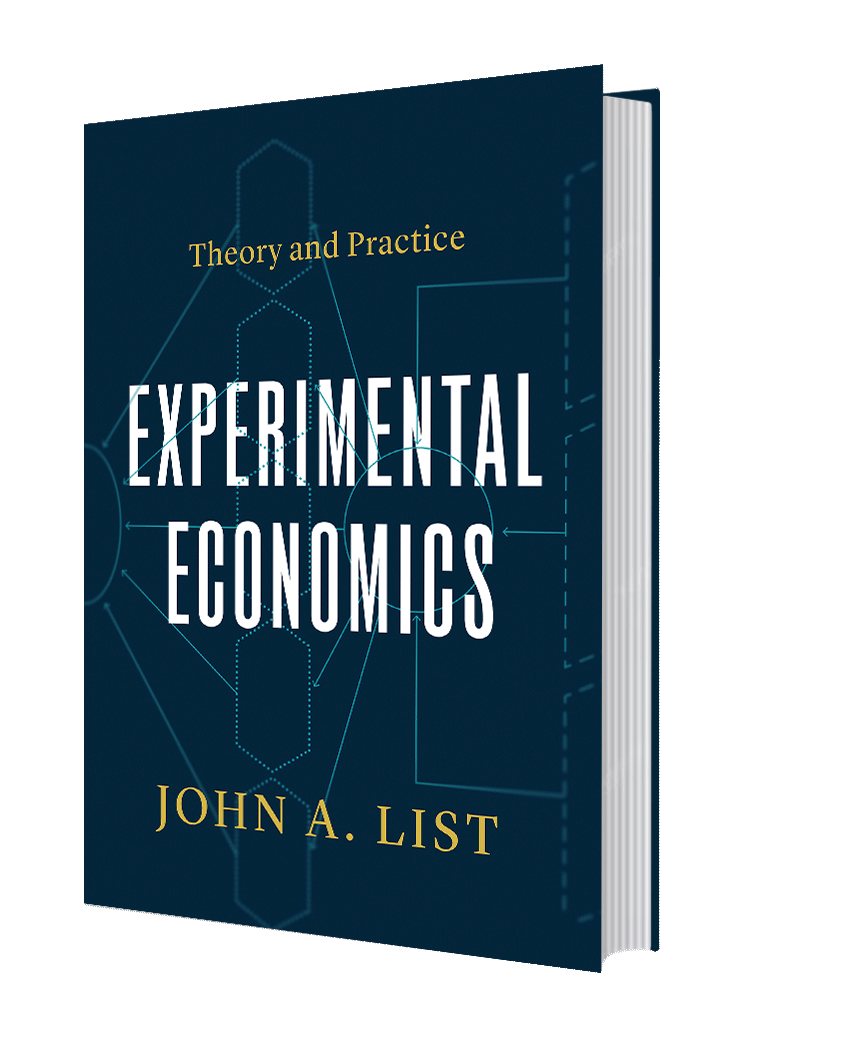
Theory and Practice
Experimental Economics
John A. List
A landmark guide from a modern pioneer in economics. As experimentation transforms the discipline—from market pricing to education policy—this book shows how to plan, run, and learn from rigorous experiments. The definitive, reference for experimental economics.
Textbook
Chapters
- Part 1 Experimental Methods in Economics: builds the causal-inference foundation—introducing the potential outcomes framework and four identifying assumptions, emphasizing the assignment mechanism, contrasting lab/field experiments with observational counterfactual methods, and covering estimation basics, including multiple-hypothesis testing.
- Part 2 Designing Economic Experiments: a practical blueprint for designing credible— covering optimal sample size and power trade-offs, randomization techniques, longitudinal and within/between-subject designs, mediation, and moderation.
- Part 3 Violations of Exclusion Restrictions: tackles assumption failures—noncompliance, attrition, interference, and dependence—clarifying what not to do, what to report, how to make valid inferences, and how to design to minimize violations.
- Part 4 Building Scientific Knowledge moves beyond internal validity—emphasizing reliability, replication, and publication bias—to build a stock of knowledge, assess construct/statistical/external validity, and design for generalizability and scaling.
- Part 5 The Ethical and Practical Sides of Economic Experiments: covers the ethical and practical backbone of experimentation—ethically responsible design, IRB and consent, preregistration and pre-analysis plans, and optimal incentive/resource allocation—showing how principled conduct and smart administration enable credible evidence as well as diffusion of research.
- Part 6 How To Supplemental Chapters: presents hands-on “How To” supplements—running experiments in markets, organizations, and with children; measuring preferences, beliefs, and constraints; and generating unconventional data.

Papers
- Lab Experiment: Experiments that employ a standard subject pool of students, an abstract framing, and an imposed set of rules.
- Artefactual field experiments: A laboratory experiment with a nonstandard subject pool.
- Framed field experiments: An artefactual field experiment with a field context in either the commodity task, or the information set that the subjects can use.
- Natural field experiments: A framed field experiment where the environment is one where the subjects naturally undertake these tasks and where the subjects do not know that they are in an experiment.